
RERA Approved Projects: Benefits, Verification Process & Buyer Guide
Let’s say that you find a property that you actually like, the price fits your budget, and the builder also seems to have everything in order. But before you pay the booking amount, have you even checked whether the project is actually registered with RERA?
- What Is RERA and What Does RERA Approval Mean?
- Which Projects Need RERA Registration in India?
- Benefits of Buying RERA-Registered Projects
- 1. You can verify the project information yourself
- 2. Developers have legal obligations to meet
- 3. There are safeguards of project funds
- 4. Property details and payment terms are clearer
- 5. You have a formal way to raise complaints
- How to Verify RERA Registration Before Buying a Property
- RERA Registration vs Other Property Approvals: What’s the Difference?
- Buyer Checklist Before Booking a RERA-Registered Property
- Conclusion
- Frequently Asked Questions
Don’t worry, we get it that it’s easy to get caught up in the location, the amenities, or how good a property looks on paper. The legal side of it, however, often gets pushed to the later part, when it really should be one of the first things you look into.
In this article, we will be talking about how RERA approved projects give you access to important project details and hold developers accountable to certain legal requirements. But there is also more to it than just checking a registration number. Just like with our other blogs here as well, we will try to Give you a clearer knowledge about all you need to know about RIRA registration.
So, if you’re planning to buy a plot, villa, or apartment, here is how you can check out a project’s RERA registration, understand the protection it offers, and support the things that deserve a closer look.
What Is RERA and What Does RERA Approval Mean?
The Real Estate (Regulation and Development) Act, 2016, was introduced to make India’s real estate sector more transparent and accountable. Before this framework existed, buyers often had limited access to project information and even fewer ways to actually raise concerns or address disputes with the developers.
So, RERA came into the picture with a simple motive to make real estate more transparent and make developers more accountable for their commitments. Many people ask the RERA approval meaning for someone planning to buy a property. Basically, as a buyer, once the project is registered, you can use its registration number to look up the available information on the official state portal.
This information can include the developer’s details, the declared completion date, sectioned plans, and other required disclosures. However, this does not automatically mean that you are free from every possible legal issue. You will still need to check the land title, applicable planning permissions, and documents that are usually related to the property you intend to buy.
For example, a plotted development may need registration under RERA as well as approval from the relevant planning authority. These documents will serve different purposes, and both of them are equally important. So, in short, RERA helps you access information about the project and understand the developer’s legal obligations. It does not remove the need to check the property’s other documents.
Which Projects Need RERA Registration in India?
Generally, RERA covers commercial and residential real estate projects, which include certain plotted developments as well. So, if you are planning to buy land rather than an apartment, do not just assume that RERA only applies to buildings, because that is so not the case!
In fact, under Section 3 of the ACT, projects usually require registration if the land exceeds 500 square meters, or the number of apartments exceeds 8, which is inclusive of all phases. There is a simple breakdown for you to understand it better:
| Property type | What buyers should know |
| Apartments | Applicable projects generally require registration before marketing or sale. |
| Villas | Requirements depend on the nature of the development and applicable rules. |
| Residential plots | Qualifying plotted developments may require registration. |
| Commercial properties | Applicable commercial projects are covered by RERA. |
| Small developments | Certain projects may qualify for statutory exemptions. |
| Previously completed projects | Some projects with the required completion certificate before the Act commenced may be exempt. |
Another very important detail that people often miss out on is that if they’re buying a plot in Phase II, for example, they just assume that the registration for Phase I automatically covers their purchase, but that is not the case. Different phases need different approvals. If you are looking at RERA-approved projects in Bengaluru, you can use the Karnataka RERA Portal to check the relevant records. Just make sure that the registration details relate to the exact development and phase that you are considering.
Benefits of Buying RERA-Registered Projects
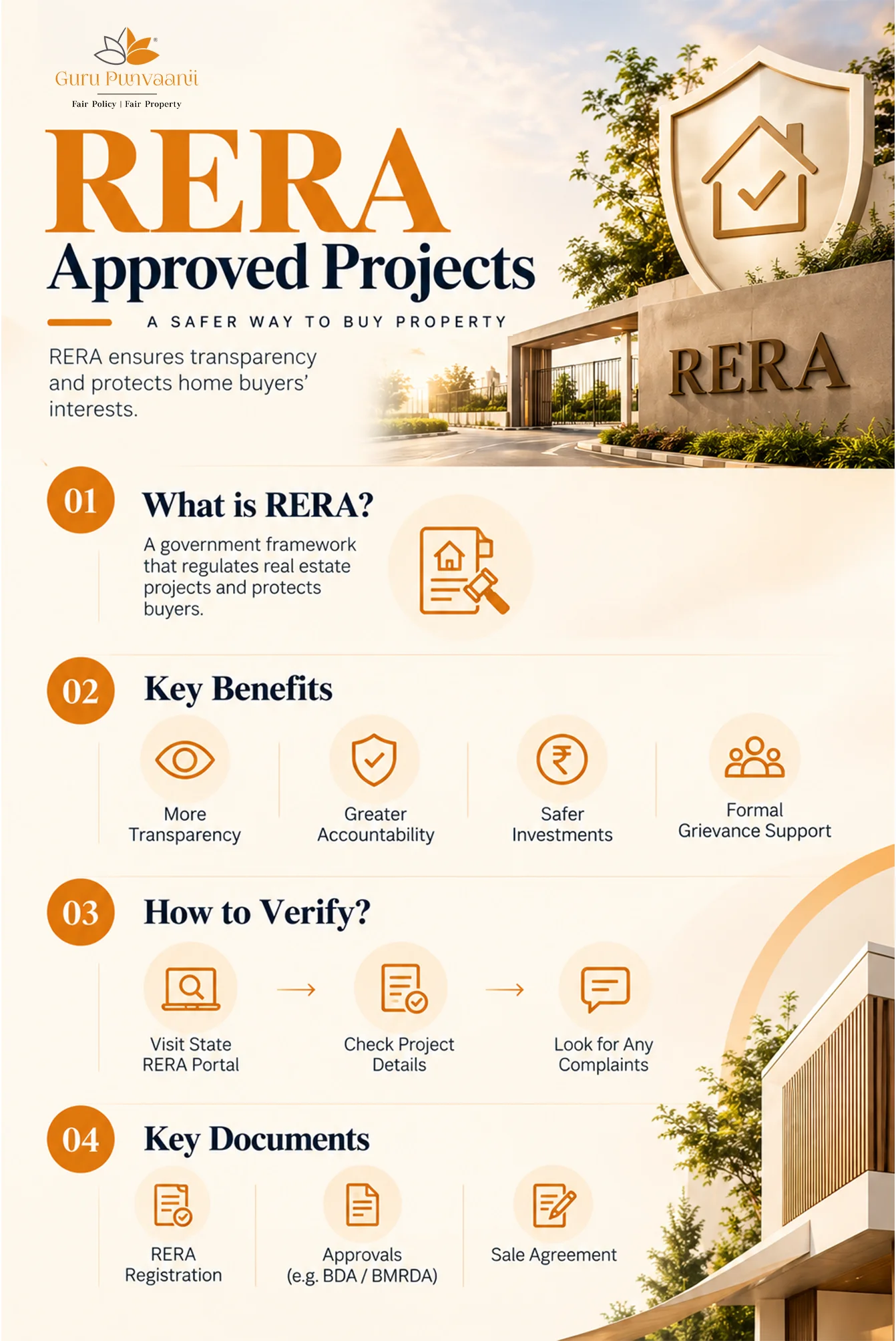
The most basic benefit of buying a RERA-registered project is that the registration gives you access to the most important information about the project and creates a framework that will keep your developer accountable for their work. But there is more:
1. You can verify the project information yourself
When you’re making such a big decision like buying a property, you cannot just trust someone’s word on it. And with RERA, you do not really have to rely entirely on what the salesperson is telling you. The official Portal will give you a way to check the project’s name, promoter details, registration status, and more.
Let’s say the brochure mentioned a particular completion date or described certain facilities. Now you can compare these claims with the official records and ask questions if something doesn’t match.
2. Developers have legal obligations to meet
When a developer has a registered project, they must follow the requirements that are related to the disclosures, construction, completion, and agreement with the buyer. If, as a developer, anyone fails to meet the obligations, then you, as a buyer, are entitled under RERA to ask! Now, of course, that does not really mean that the delays can never happen, but it just means that there’s a legal framework, rather than leaving buyers entirely dependent on informal discussions over the phone.
3. There are safeguards of project funds
Now there’s also a rule that says that under RERA, developers must keep 70% of the money collected from the buyer in a separate bank account. This money is supposed to cover the cost of the land and the construction of that particular project, and developers can only withdraw it by meeting certain conditions, which include getting the required certifications of the project.
Now you may wonder why this rule exists in the first place. Well, the purpose is simply to make sure that the money that is collected for a project is used for that particular project only.
4. Property details and payment terms are clearer
On the RERA portal, you can also see what carpet area you are getting and the final agreements for the sale. This, as a buyer, will help you understand what exactly you are paying for and compare the properties more fairly.
Before signing anything, you can keep a check of the carpet area, total price, payment schedule, and additional charges. So, if the salesperson is quoting one price, but the agreement is showing another, then you can ask for an explanation.
5. You have a formal way to raise complaints
It is also very common for some developers to violate the applicable provisions or obligations. In such a case, as a buyer, you will be able to approach the relevant RERA authority to ask your questions. This is one of the remedies that will ensure that, during a dispute, you can file a formal complaint and seek a solution when certain issues arise.
At Guru Punvaanii, we ensure fair policies and transparency throughout our process, so you never have to worry while following your dreams!
How to Verify RERA Registration Before Buying a Property
Step 1: Ask for the registration number
Step 2: Visit the official state RERA website
Step 3: Check whether the details match
Step 4: Look at the available documents
Step 5: Check for complaints and orders
Step 6: Save the information you find
RERA Registration vs Other Property Approvals: What’s the Difference?
When there are so many approvals and documents to keep track of, it can be confusing to keep all the paperwork ready. But you will understand what RERA approval meaning is once you understand how registration fits into the larger picture and how it is different from other property approvals.
| Document | What it generally covers | What you should check |
| RERA registration | Registration of an applicable real estate project | Project details, status and disclosures |
| BDA/BMRDA or other planning authority approval | Planning and layout matters within the authority’s jurisdiction | Approved layout and applicable conditions |
| Building plan sanction | Approval of building plans | Whether the proposed construction follows the sanctioned plan |
| Land title documents | Ownership and the seller’s rights over the land | Title history, encumbrances and relevant disputes |
| Khata or municipal records | Property-related administrative or tax records, depending on the document | Whether the records are appropriate for the property and transaction |
Buyer Checklist Before Booking a RERA-Registered Property
Before paying a booking, amount or signing an agreement, go through this checklist. You can also use it to compare different properties without missing important details.
| What to check | Questions to ask |
| Registration number | Does it match the project and phase I want to buy? |
| Registration status | Is the registration current? Are there relevant extensions? |
| Promoter details | Does the registered promoter match the seller? |
| Project location | Do the official records match the actual site? |
| Plans and approvals | Are the relevant plans and permissions available? |
| Completion date | What date has been declared? Has it changed? |
| Project disclosures | Do the records support the important claims in the brochure? |
| Complaints and orders | Are there relevant records that need further investigation? |
| Land title | Has a lawyer reviewed the ownership documents? |
| Agreement for sale | Are the price, payment schedule and possession terms clear? |
When comparing RERA-approved projects, you can use this checklist for every property. This will make it easier for you to compare the paperwork instead of getting swayed!
Conclusion
You do not need to become a property expert before you buy a new plot or a villa, but what you should know is what you are paying for and where to check the information that you have been given. This is exactly where understanding RERA approval will help you ask better questions and make a wiser decision.
At Guru Punvaanii, we encourage buyers to understand the paperwork before making a decision. You can explore our projects and contact our team for project-specific information.
Frequently Asked Questions
1. How can I check if a real estate project is RERA registered in Karnataka?
First, you need to ask the seller for the registration number of the project. Then you can look it up on the Karnataka RERA portal. Check the project name, promoter’s details, and registration status. Match what you have been told and make sure that the registration is for the exact phase that you’re buying into. Check the RERA registration guide, charges, and required documents to understand the verification process better.
2. What is the meaning of RERA approval, and why is it important when buying a property?
It basically means that the project is registered under the Real Estate (Regulation and Development) Act, 2016, so you can look up its details on the official state portal. This includes developer info, declared completion date, plans, and other disclosures. Before investing, read documents to check before buying a property to understand the importance of property verification.
3. How can I check the RERA approval status of a villa project in Bangalore?
You need to have the registration number so you can look it up on Karnataka RERA portal and check that the registration is current and updated.
4. What is the difference between Karnataka RERA approval and BMRDA-approved layouts?
They actually do different jobs. On one hand, RERA registration covers the real estate projects itself, which includes its details, status, and disclosures, while BMRDA or BDA approval covers planning and layout matters within that authority’s jurisdiction. And if you’re going for a plotted development, then you will need both, as one does not replace the other.