
What Is Saleable Area? Everything Homebuyers Need to Know
If you have ever gone house-hunting in Bengaluru, you have probably come across the terms like salebale area, carpet area, and built-up area. And yes, at first, they sound pretty complicated and confusing but actually have very different meanings and purposes.
- What is Saleable Area?
- How Is Saleable Area Calculated? (Step-by-Step Guide)
- Step 1: Calculate the carpet area
- Step 2: Add Built-up area
- Step 3: Add common area loading
- Step 4: Final Saleable Area
- What Is Included in Saleable Area?
- Is Saleable Area Important When Buying a property?
- Final Thoughts
- Frequently Asked Questions
- Q1. How do I calculate carpet area from saleable area?
- Q2. What is a good saleable-to-carpet area ratio when buying a flat?
- Q3. Does saleable area include balcony and terrace space?
- Q4. What is saleable area in real estate?
- Q5. What is the formula for saleable area?
Also, you are not alone when it comes to this confusion, as it gets complicated to actually understand the size of the house. One term that creates the most confusion is the saleable area. In a city like Bengaluru where new housing projects are constantly launching and property prices fluctuate; it becomes important to understand exactly what you are paying for.
In this guide, we will answer all your questions on what is saleable area, how to calculate it, and much more! So, without any further ado, let’s get into it!
What is Saleable Area?
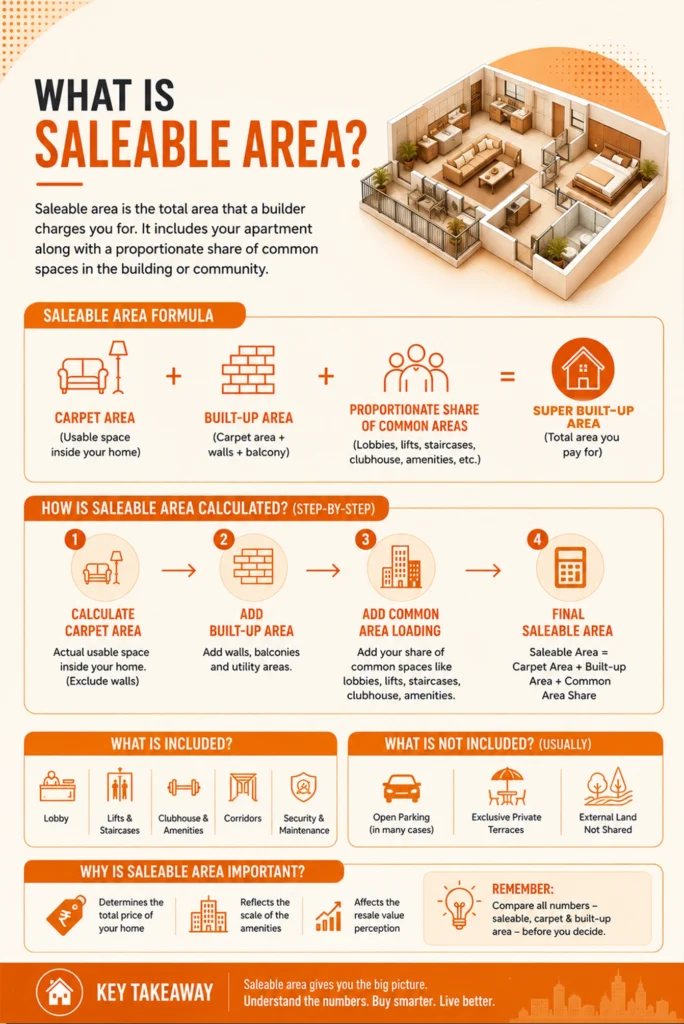
Let’s start with the basics first and understand what this area is! If we put it in simple terms, it is basically the total area that a builder charges you for. It not only includes your apartment, but also a share of common spaces in the building or community.
For example, when you are buying a flat, you are not just paying for the living room, bedroom, or kitchen. Here, you also contribute to shared spaces like lobby, staircase, lift, clubhouse, etc.
So, in short, what is saleable area really made up of?
- Carpet Area (actual usable space inside your home)
- Built-up Area (carpet area + walls + balcony)
- Proportionate share of common areas
You might assume that a 1,200 sq. ft. apartment means you will be getting 1,200 sq. ft. of usable space. But well, that is not the case! In reality, the usable portion can be significantly lower as well. This is why understanding the saleable area vs carpet area vs built-up area gets very important before you make any decisions.
How Is Saleable Area Calculated? (Step-by-Step Guide)
Now that you understand what is saleable area, the next logical step is to understand how to calculate it. Let’s break it down!
Step 1: Calculate the carpet area
This is the space that you will actually be using when living. You can think of it as a space where you can place your furniture, walk around, but make sure to exclude the walls.
Step 2: Add Built-up area
This area includes:
- Internal and external walls
- Balconies and utility areas
Step 3: Add common area loading
Now comes the most important part, which is the loading factor. This basically includes the shared spaces such as:
- Lobbies
- Elevators
- Staircases
- Clubhouse
- Amenities
and well, this is distributed across all apartments!
Step 4: Final Saleable Area
Now you can finally use the ultimate formula, which is:
Saleable area= Carpet area + Built-up Area + Common Area Share
The reason why this matter is because it can make a huge difference in the space you are actually paying for.
What Is Included in Saleable Area?
One of the biggest reasons why buyers and investors get so confused with the saleable area is because of what it includes and what it doesn’t. Here is a list of spaces and areas, saleable area usually covers:
- Lobby and reception areas
- Staircases and lift shafts
- Corridors and hallways
- Clubhouse and gym
- Swimming pool and recreational spaces
- Security rooms and maintenance areas
In fact, for premium projects, this can also include landscaped gardens and rooftops, which you can find at Guru Punvaanii. In short, when you see a higher saleable area, it often means you’re paying for better amenities and infrastructure.
Despite everything being added, certain things are usually not part of saleable area:
- Open parking spaces (in many cases)
- Exclusive private terraces (depends on builder)
- External land not directly shared
Is Saleable Area Important When Buying a property?
Yes! It is very important that you know the total saleable area of the property you are investing your future in. The reason why it matters is because:
- It determines the total price of your home.
- It reflects the scale of the amenities.
- It affects the resale value perception.
so yes, overall, it does play a big role. But here is a catch! A larger scale area can also sometimes be misleading. For example, let’s take two apartments:
Flat A: 1,200 sq. ft. saleable
Flat B: 1,200 sq. ft. Saleable
Now, Flat A might give you about 900 sq. ft. of actual usable space, while Flat B gives you only 800 sq. ft.
This is why, when you are comparing the properties, don’t just rely on one number, but rather all numbers. Yes, the saleable area gives you an overall idea, but if the carpet area is too small, then it will not be a smart decision!
This is what smart buyers do:
- They always ask for the carpet or the actual usable area.
- Compare the price per square foot based on the carpet area
- Then they also keep a check of the loading percentage.
- Lastly, they very well understand the difference between built up area vs saleable area clearly.
Final Thoughts
Now that you have a clear understanding of what is a saleable area and why it matters, it’s important to also know that being a smart buyer means being knowledgeable. These are not just the numbers, but pricing tools and a representation of the infrastructure. So, next time you are comparing properties, don’t just rely on what’s advertised or who advertised better, but rather dig deeper. If you are exploring properties in Bengaluru, you can also learn about Guru Punvaanii and our approach to developing residential and plotted communities.
At the end of the day, you are not just buying square footage but a home that you will be living in every single day! So, pay a visit to our site, or give us a call and Contact us with your questions.
Frequently Asked Questions
Q1. How do I calculate carpet area from saleable area?
You can simply estimate it by reversing the loading percentage. So basically, if the loading is 30%, you can divide the area by 1.3. So, the 1,300 sq. ft. saleable becomes roughly 1,000 sq. ft. built-up, and around 800 sq. ft. Carpet. For a better understanding of these measurements, read about carpet area.
Q2. What is a good saleable-to-carpet area ratio when buying a flat?
A healthy ratio that you should keep in mind lands somewhere between 65% to 70% carpet area of the salebale area. Simply put, the higher the carpet percentage, the better it is for you as a buyer as you will get more home space you will actually be using.
Q3. Does saleable area include balcony and terrace space?
Yes! Balconies and terraces are usually a part of built-up area, and so automatically it counts in the saleable area as well.
Q4. What is saleable area in real estate?
In real estate, a saleable area means the total area for which you, the buyer, is charged. So, it includes the apartment built-up area along with the actual usable area and common spaces. ou can also explore our home buying guide for other important factors to consider before purchasing a property.
Q5. What is the formula for saleable area?
It’s simple math: Saleable Area = Carpet Area + Built-up area + proportionate share of common areas.