What Is FSI
Property Buying Guide

What Is FSI (Floor Space Index) & Why It Matters for Plots

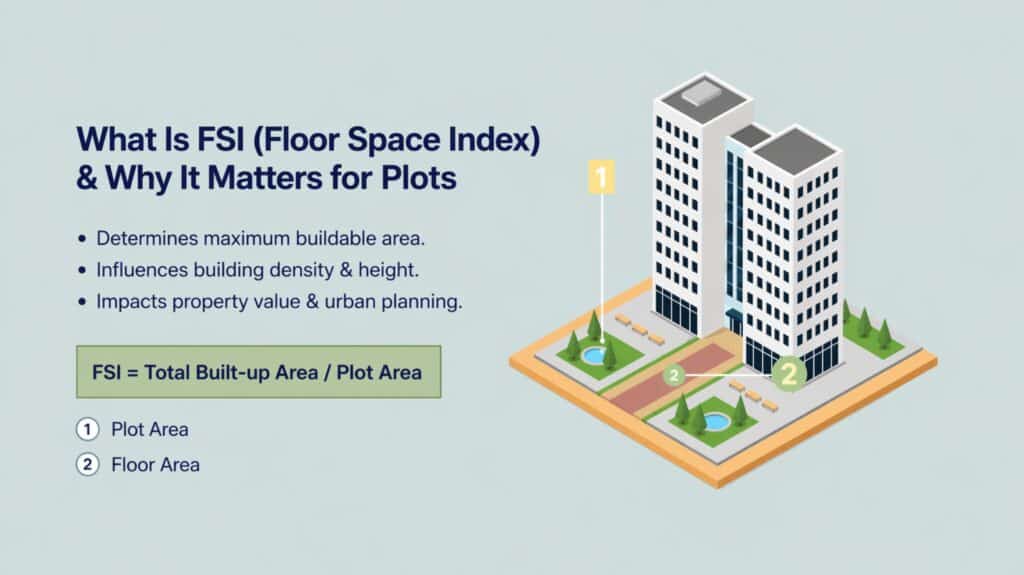
If you ask us what one of the most important things is when buying or developing a plot, then the answer would probably be FSI. What is that? Well, if you have ever wondered, “What is floor space index?” or “What does FSI mean in real estate?“ Then you’re in the right place. This is one of those things that can make or break your whole project. Plus, choosing the right developer can also change your whole experience with real estate.   In this article, you will understand not just what FSI is, but how you can calculate it, why it matters, and how it can benefit you!   What Is the Floor Space Index (FSI)? Let’s keep it simple! The Floor Space Index, commonly abbreviated as FSI, is a number that tells you how much construction you can do on a piece of land. You can think of it as a ratio of the total built-up area to the area of your plot. You might have heard people saying “Floor Area Ratio” (FAR), but whether you call it FSI or FAR, they mean the same thing.   To understand it better, here is an example for you:  If your plot size is 1,000 sq. ft. and the allowed FSI is 2, it means you can build up to 2,000 sq. ft. of total floor area. This can be spread across multiple floors as per the city’s regulations. And that’s exactly why FSI is so important in real estate! It directly affects how tall or large your building can be and, in turn, the value of your property.  When people ask, “What is FSI in real estate?” A lot of them imagine it as a limit or a rule, but it is really more like a tool. It will help the planners, developers, and buyers to understand what can be built without overcrowding the city! How Does FSI Work? Now that you know what is FSI in real estate, it’s time to learn how exactly it works. Basically, FSI works by regulating how much construction can happen on a plot while keeping the city livable. Here’s a simple way to think about it:  How much ground is covered? Ground coverage refers to how much of your plot area you can cover with a building footprint. This is also often linked to FSI because they both are controlled by local development regulations.   The ground coverage formula is simple:  Ground Coverage (%) = (Plot Area / Area of Ground Floor) ×100  So, for example, if your plot is 1,000 sq. ft. and the ground floor occupies 500 sq. ft., your ground coverage is 50%. Multiple Floors FSI allows you to stack construction vertically so that you can have floors. So, if you have a high FSI, that means you can build more floors and eventually increase your total build-up area. This is the reason why developers often check FSI before buying a plot.   City Planning Different cities have different FSI limits that are based on the neighbourhood, infrastructure, and how much open space is required. Now, a high FSI might be allowed in a commercial area but still can be restricted in the residential zone.   So, it’s all about the balance FSI maintains between the space usage and urban density. Without it, cities would either sprawl endlessly or the crowd would not have space to walk.   How to Calculate FSI?  Calculating FSI is simpler than it sounds once you know the formula.  FSI = Plot Area / Total Built-up Area   Now let’s look at this with an example as well:  Plot size = 1,500 sq. ft.  Total built-up area planned = 3,000 sq. ft.  FSI = 3,000 ÷ 1,500 = 2  So, the FSI for this plot is 2. However, there can also be redevelopment, for which there is a different way to calculate. Redevelopment projects often have slightly different rules. You might be allowed a higher FSI than the original building had. Here’s how to approach it:  Check the existing FSI and know the current status of the plot or building.  Municipalities often give extra FSI for redevelopment to encourage modern, safer construction, so make sure to check the government’s norms.   Multiply the plot area with the allowed FSI.  For example: If your 2,000 sq. ft. plot has an allowed FSI of 3 for redevelopment, you can build up to 6,000 sq. ft. of total floor area.  Knowing how to calculate FSI for redevelopment helps you plan better and take advantage of government incentives.  What is the Importance of FSI? You might wonder, “Why bother with FSI?” Here’s why it matters:  If there is a higher FSI, then it means you can have more floors or apartments, which in turn will increase the value of the property.  There are legal compliances! Building beyond the allowed FSI can be a one-way ticket to penalties, fines, or even demolition.  Knowing what floor space index is can help investors and developers to forecast and estimate the returns and plan layouts.   FSI does a great job at making sure that cities grow responsibly to avoid overcrowded streets and maintain open spaces.   This way,   You can maximize space.  Optimize the costs.  Boost your revenue.  Have open space for ventilation, sunlight, and greenery.  Better planning and organization.  Common Mistakes You Can Avoid!  Did you know that even experienced buyers make mistakes when it comes to FSI? Here is how you can learn from it and avoid following wrong advice:  Do not just calculate FSI but also remember that your ground cannot exceed the allowed coverage. Many people actually ignore the ground coverage!  High FSI does not mean you can have unlimited floors. No! If the local rules have restrictions on floor height, then you will have to follow them.   Talking of local rules, many people just skip them. But FSI varies by city, neighbourhood, and even zones. So, you should always check the municipal norms.   Another very common one is that people include the non-eligible area and consider it an obvious inclusion. This includes staircases, balconies, and parking spaces, which may or may not count towards FSI, depending on local rules.  With Guru Punvaanii, you get more than just land—you get the expertise to maximize its potential. Our team helps you navigate complex regulations like FSI, ensuring you can build to the fullest while staying compliant.  Let’s build your dream project together. Get in touch with Guru Punvaanii to find the perfect plot!  Conclusion Our final thoughts are